The Copernicus Data Space Ecosystem, is an open ecosystem that provides free instant access to a wide range of data and services from the Copernicus Sentinel missions and more on our planet’s land, oceans and atmosphere. This package provides entry points to several APIs allowing users to access the data directly in R.
Installation
Install CRAN release:
install.packages("CopernicusDataspace")Install latest developmental version from R-Universe:
install.packages("CopernicusDataspace", repos = c('https://pepijn-devries.r-universe.dev', 'https://cloud.r-project.org'))Introduction
The Copernicus Data Space Ecosystem offers access to its services through several APIs. This package offers access via the following APIs. This README shows only essential methods for downloading data. For more detailed information consult the respective vignettes:
-
OData; details in
vignette("OData"), -
STAC; details in
vignette("STAC"), and -
SentinelHub; details in
vignette("SentinelHub").
Authentication
When actually downloading files from the Copernicus Data Space Ecosystem, you usually need some form of authentication. Examples below use credentials stored as environment variables. For more information about how to effectively authenticate download requests, please see vignette("Authentication").
Downloading Using STAC Catalogue
When you know the STAC identifier (asset_id) and the asset name you wish to download, you can simply use the example shown below. It will often speed you request up if you include the collection id. When you don’t know these details, you should first explore the catalogue. Please see vignette("STAC") for more details on working with the STAC catalogue.
library(CopernicusDataspace)
library(stars) ## For reading and plotting the downloaded file

## Only run this if an S3 secret is specified:
if (dse_has_s3_secret()) {

  filename  <- dse_stac_download(
    asset_id   = "Copernicus_DSM_COG_30_S69_00_W062_00_DEM",
    asset      = "data",
    collection = "cop-dem-glo-90-dged-cog",
    tempdir())

  tile_stac <- read_stars(filename)

  plot(tile_stac, col = hcl.colors(100), axes = TRUE)

}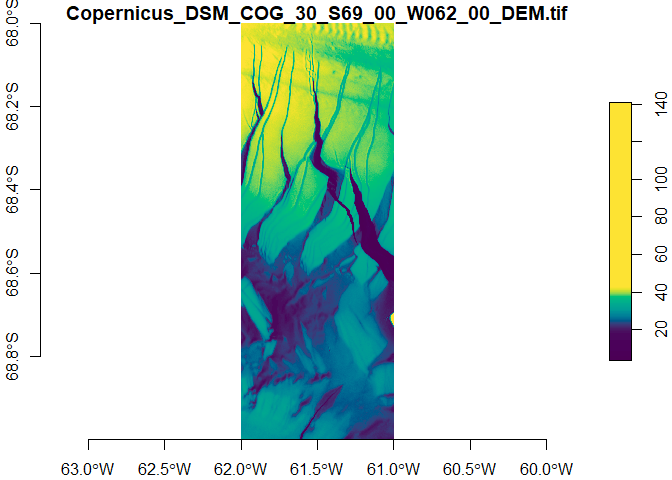
This produces a tile in the Southern Ocean near Antarctica.
Downloading Using OData API
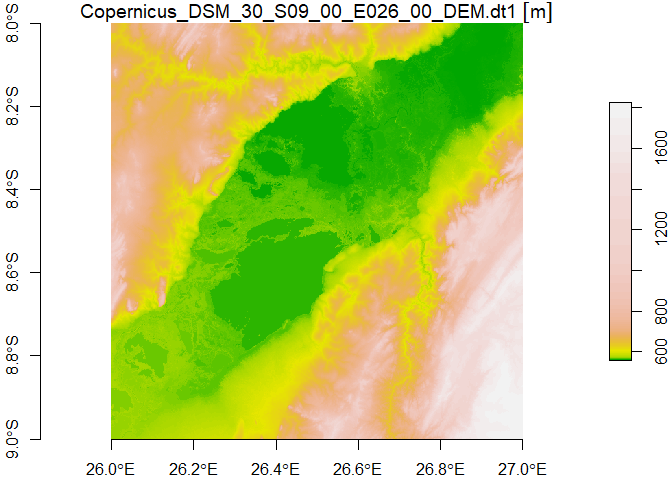
The example below briefly demonstrate how to download data using with the OData API wrapped by this package. This produces a map of Lake Upemba in Congo. For more extensive information about the API and workflow check out vignette("OData").
## Only run this if client info is available:
if (dse_has_account()) {
  response <-
    dse_odata_download_path(
    product     = "2f497806-0101-5eea-83fa-c8f68bc56b0c",
    node_path   = paste(
      "DEM1_SAR_DTE_90_20101213T034716_20130408T035028_ADS_000000_5033.DEM",
      "Copernicus_DSM_30_S09_00_E026_00", "DEM",
      "Copernicus_DSM_30_S09_00_E026_00_DEM.dt1", sep = "/"),
    destination = tempdir())

  tile_odata <- read_stars(response$body)
  plot(tile_odata, col = terrain.colors(100), axes = TRUE)
}
Downloading Using SentinelHub
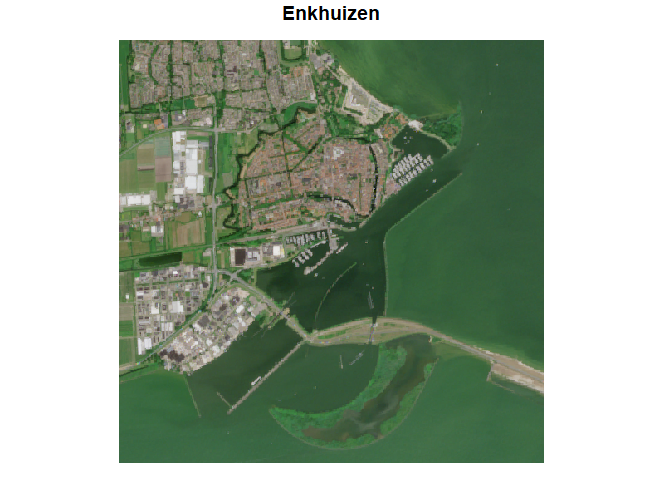
SentinelHub is a service that remotely processes raw Sentinel data and returns the result. Below a quick demonstration of the process. For more detailed information check vignette("SentinelHub")
## Only run this if client info is available:
if (dse_has_client_info()) {
  bounds <- c(5.261, 52.680, 5.319, 52.715)

  ## prepare input data:
  input <-
    dse_sh_prepare_input(
      bounds = bounds,
      time_range = c("2025-06-01 UTC", "2025-07-01 UTC")
    )

  ## prepare ouput format:
  output <- dse_sh_prepare_output(bbox = bounds)

  ## retrieve processing script:
  evalscript <- dse_sh_get_custom_script("/sentinel-2/l2a_optimized/")

  ## destination file:
  fl <- tempfile(fileext = ".tiff")

  ## send request and download result:
  dse_sh_process(input, output, evalscript, fl)

  ## read and plot result:
  enkhuizen <- read_stars(fl) |> suppressWarnings()
  plot(enkhuizen, rgb = 1:3, main = "Enkhuizen")
}
Function Names
Understanding the naming logic of the functions in this package, will help you navigating through all features, and effectively use them.
Most function names in this package start with the acronym dse (Data Space Ecosystem). This is done to avoid confusion with other Copernicus packages (see below) and unintended masking of other functions.
Exceptions are functions that (intentionally) mask functions from other packages (like req_perform()), and functions that implement generic functions from tidyverse packages (see ?tidy_verbs).
Functions are also grouped to highlight the specific API they support. After the dse acronym, these function names contain a reference to the relevant API (odata, stac and sh (SentinelHub)). If a function name starts with dse but is not followed by a reference to a specific API, it will have a more generic purpose (like for instance authorisation).
OpenEO
OpenEO is and will not be supported by the package at hand. It has a dedicated R package on CRAN: openeo, with additional documentation available at copernicus.eu. OpenEO allows to process data remotely and retrieve only processed data.
More of Copernicus
More R packages for exploring other Copernicus data services:
- CopernicusClimate Dedicated to climate change datasets
- CopernicusMarine Dedicated to marine datasets
Code of Conduct
Please note that the CopernicusDataspace project is released with a Contributor Code of Conduct. By contributing to this project, you agree to abide by its terms.
Acknowledgement
This software has been developed as part of the statutory task programme “fisheries research” and is subsidised by the Dutch Ministry of Agriculture, Nature and Food Quality.